Author: PMCS

  • Case Study: Power to the People – How the AVCO Center Released Hidden Capacity and Cut Reactive Power by 97%

    Case Study: Power to the People – How the AVCO Center Released Hidden Capacity and Cut Reactive Power by 97%

    Organization Overview

    The AVCO Center is a 142,300-square-foot commercial office building with a diverse electrical load profile that includes HVAC systems, chillers, elevators, parking infrastructure, and tenant equipment. As a mid-rise urban building with centralized electrical distribution, managing demand, power quality, and transformer capacity was critical to long-term performance and reliability.

    To support its operations, the building is served by a 3,000 kVA transformer, supplying a 480V, 3-phase main bus with highly variable daily demand patterns.

    The Challenge

    Despite stable occupancy, the AVCO Center faced several electrical inefficiencies common to commercial office buildings:

    • Elevated reactive power (kVArh) driven by inductive loads
    • Excess supply capacity (kVA) required to overcome end-load VAR
    • Suboptimal power factor across operating hours
    • Increased transformer and infrastructure stress
    • Rising energy costs without corresponding increases in usable power

    Traditional efficiency measures did not address the root electrical inefficiencies occurring inside the building’s network.

    The Solution

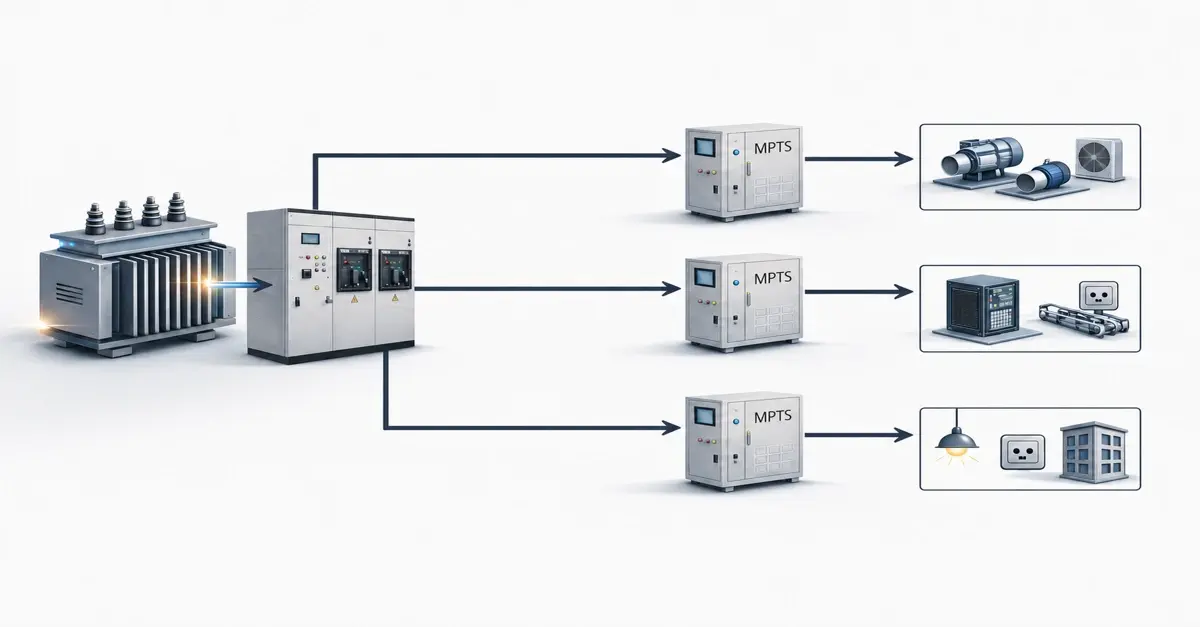
    After a full engineering assessment, three MPTS™ H240 units were installed behind the meter in strategic locations:

    • 1 unit in the 13th-floor chiller room
    • 2 units on Level B near the main electrical bus

    The installation followed a rigorous process:

    • Utility bill analysis and single-line review
    • Seven-day pre-installation electrical fingerprinting
    • Independent pre- and post-installation metering
    • Continuous live interval data monitoring

    The entire system was installed and commissioned in two business days, with no downtime, no equipment replacement, and no tuning or load interruption

    The Results

    Measured and verified performance showed substantial and sustained improvements:

    Electrical Performance Improvements

    • 17.8% reduction in supplied kVAh
    • 96.8% reduction in reactive power (kVArh)
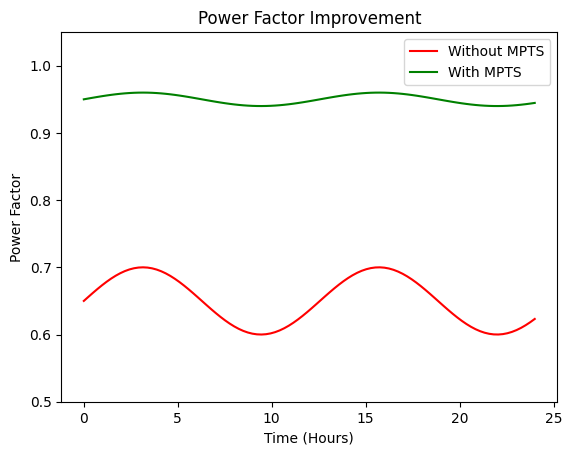
    • Power factor improved from 0.85 to 0.99
    • Average of 69.3 kVAh of capacity released per hour

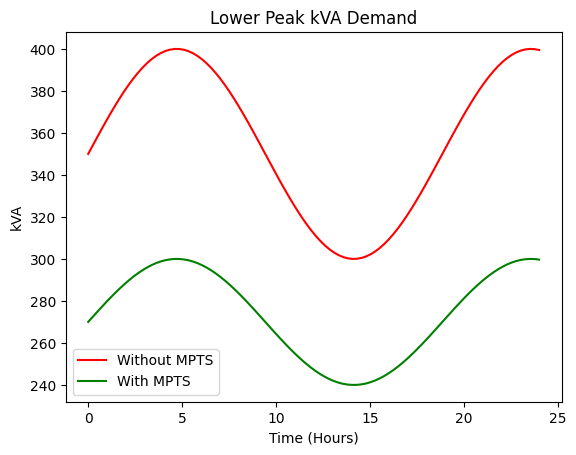
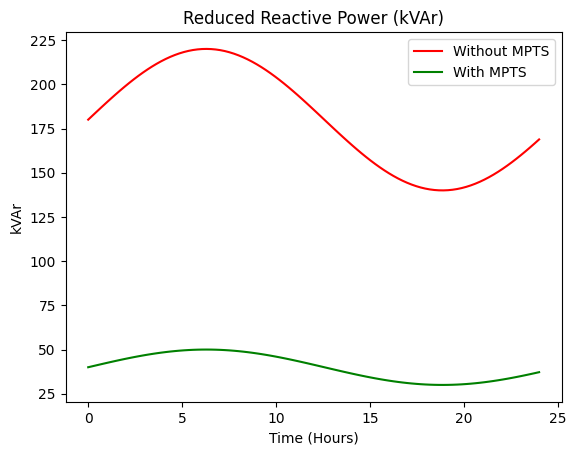
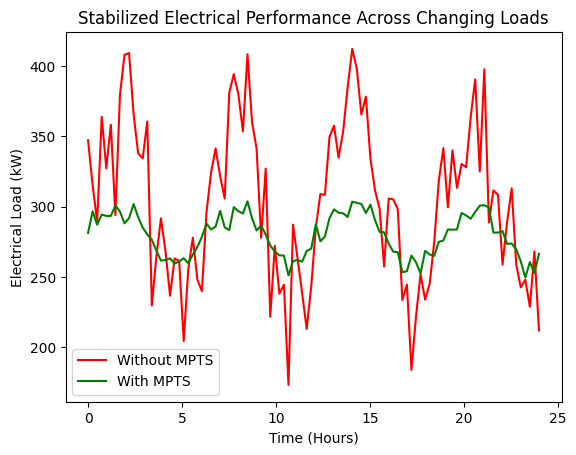
    Fourteen-day electrical fingerprints before and after installation show a dramatic collapse in reactive power and stabilization of supply demand across all operating hours

    Capacity & Carbon Impact

    • 607 MVAh of capacity released annually
    • 12,140 MVAh released over system life
    • 269.8 metric tons of CO reduced annually
    • 5,396 metric tons of CO avoided over system life

    These gains were achieved without changing a single end-use device — purely by improving how electricity flows through the building.

    Why This Matters

    The AVCO Center demonstrates critical insight for commercial buildings:

    Energy efficiency isn’t just about consuming less — it’s about using power correctly.

    By removing end-load VAR and reclaiming wasted capacity, MPTS unlocked infrastructure headroom, reduced emissions, and improved long-term reliability — all while remaining maintenance-free.

    Ideal Applications

    • Commercial office buildings
    • Mixed-use developments
    • High-rise HVAC and chiller plants
    • Parking and elevator-intensive facilities

    Read the white paper.

  • MPTS Financial Impact & ROI is Utterly Compelling

    MPTS Financial Impact & ROI is Utterly Compelling

    1× and 2× Maximum Power Transfer Solution Deployment

    NORAD

    At 3,000’ below in Cheyenne Mountain, very large compressors (one replaced annually) created pneumatic instead of conventional power because of the heat. Annual compressor replacement stopped after an MPTS 2015 installation, and none have been replaced since. At $480,000+ per compressor, saved since 2015, the CAPEX avoided = $5,280,000 vs $240,000 MPTS cost.

    National Hospital

    Prior to a 2019 chiller replacement at a cost of $1,000,080 due to poor, inefficient operation, MPTS was installed as a test to “clean the dirty power” and provide “as-per-design” operating conditions. The chiller is still operating. CAPEX avoided = $1,080,000 vs $240,000 MPTS cost.

    School District

    An Arizona School District high school’s I.T. building, with its associated server equipment and terminals, was hit with a 1,600V utility power surge.  An MPTS unit installed in 2021 suppressed the surge without causing any damage. CAPEX avoided = $720,000 vs $120,000 MPTS cost.

    County Prison

    The prison, also a nonstop-producing factory, achieved its MPTS 1-year ROI by reducing preventive and emergency maintenance by 43%, enabling two technicians to be reassigned to the county courts rather than hiring new ones. CAPEX avoided $120,000 in MPTS costs.

    Executive Summary

    This report evaluates the return on investment for two deployment configurations of the Maximum Power Transfer Solution (MPTS): a single-unit (1× MPTS) at a fully installed cost of $200K, and a dual-unit (2× MPTS) at a fully installed cost of $400K. Both configurations are assessed across recurring OPEX savings, avoided capital expenditure (CAPEX), transformer asset recovery, and overall payback profile.

    Both deployments address a critical infrastructure problem: power asset transformers operating beyond 100% capacity (the same applies to BESS, UPS, Gensets, and Solar). The MPTS resolves this by eliminating reactive power, reducing demand load, and recovering usable transformer capacity — deferring or eliminating the need for costly electrical infrastructure upgrades. MPTS is first and foremost a Power Management Control System (PMCS).

    Deployment Comparison Overview

    Metric1× MPTS ($200K)2× MPTS ($400K)
    Capital Investment$200,000$400,000
    Annual OPEX Savings$42,217 – $60,297$85,754 – $129,914
    CAPEX Avoided$140K – $310K$270K – $540K
    Transformer Loading100%+ → 86%100%+ → 77%
    Reactive Power Eliminated400 kVAR → −7400 kVAR → −14
    Payback Period: Both / OPEX / CAPEX1-2 / 3-5 / 1-2 years1-2 / 3-5 / 1-2 years

    OPEX Assessment

    Both deployment scenarios produce strong, recurring operational savings driven by four distinct mechanisms:

    1. Energy Savings
      The 2× MPTS (600 kVA / 450 kW / 400 kVAR / 0.75 PF) deployment eliminates 245,280 kWh annually, and the 1× unit (360 kVA /300 kW / 200 kVAR / 0.83 PF) eliminates 122,640 kWh annually. At $0.12/kWh, this yields annual energy savings of approximately $29,434 and $14,717 respectively — a direct, measurable reduction in utility consumption.
    2. Demand Charge Reduction
      Demand savings follow directly from the kVA reductions achieved. The 2× deployment recovers 136 kVA on a 600 kVA transformer, generating $16,320–$24,480 per year in demand savings. The 1× unit frees 51 kVA on a 360 kVA transformer, yielding a more modest $5,100–$9,180 annually.
    3. Power Factor Penalty Elimination
      Both configurations eliminate power factor penalties charged by the utility. At 2% of the annual utility bill, this adds a clean, predictable saving of $9,000/year for the 2× configuration ($450K annual utility) and $5,400/year for the 1× ($270K annual utility).
    4. Transformer & Cooling Loss Reduction
      Reduced electrical losses in transformers and associated cooling infrastructure, combined with lower mechanical stress on equipment, contribute an estimated $16,000–$32,000 annually (2×) and $12,000–$16,000 (1×), alongside operational and maintenance savings of $15,000–$35,000 and $5,000–$15,000 respectively.
    OPEX Savings Category1× MPTS / Year2× MPTS / Year
    Energy savings (kWh)$14,717$29,434
    Demand charge reduction$5,100 – $9,180$16,320 – $24,480
    Power factor penalty elimination$5,400$9,000
    Transformer & cooling losses$12,000 – $16,000$16,000 – $32,000
    Operational & maintenance$5,000 – $15,000$15,000 – $35,000
    Total annual OPEX savings$42,217 – $60,297$85,754 – $129,914

    CAPEX Assessment

    The more significant financial argument is the deferral and avoidance of capital expenditure. Both scenarios address transformers operating beyond 100% rated capacity. The MPTS resolves this without physical infrastructure replacement, avoiding the following capital outlays:

    Avoided CAPEX Item1× MPTS2× MPTS
    Transformer replacement$30K – $60K$75K – $150K
    Utility infrastructure upgrade$30K – $75K$40K – $80K
    Backup capacity (GenSet/UPS)$50K – $100K$80K – $160K
    Extended transformer service life$30K – $75K$75K – $150K
    Total CAPEX avoided$140K – $310K$270K – $540K

    The 2× deployment reduces transformer loading to ~77%, providing significantly greater headroom for future load growth compared to the 1× unit’s ~86% loading. Both values represent safe operational targets versus the pre-deployment overload condition.

    Payback & Risk-Adjusted View

    The stated 1–2-year payback applies to both configurations and is credible if the CAPEX avoidance items are treated as near-term obligations rather than as hypothetical deferments.

    Key considerations:

    • If the transformer replacement, utility upgrade, or backup power generation has already been budgeted or is imminent, the ROI case is extremely strong, and the net payback may be achieved within the first year.
    • If these expenditures remain discretionary, the OPEX-only payback of approximately 3–5 years remains a reasonable return for electrical infrastructure investment.
    • The 2× deployment delivers approximately 2× the annual OPEX savings and 2× the CAPEX avoidance upside, meaning the incremental $200K investment for the second unit carries the same ROI profile as the first — an unusual characteristic suggesting both transformers are equally stressed.
    • Reactive power correction to a slightly leading condition (−7 to −14 kVAR) is an optimal operating point, providing a built-in voltage-stability margin.

    Strategic Asset Impact

    Beyond the financial metrics, both deployments unlock operational and growth-oriented benefits:

    • Eliminates infrastructure bottlenecks and overload risk without capital construction
    • Enables facility growth without requiring new electrical service or transformer upgrades
    • Improves power reliability, equipment longevity, and energy efficiency
    • Frees 23% of transformer capacity (2×) or 14% (1×) for future load allocation
    • Extends the useful service life of existing transformer assets
    MPTS Financial Impact Summary
    1 × MPTS Deployment — $200K (All inclusive)
    MPTS Financial Impact Summary
    2 × MPTS Deployment — $400K (All inclusive)
    Annual OPEX Savings $86K – $130K Annual OPEX Savings
    (Validated + modeled recurring operational savings)
    $86K – $130K Annual OPEX Savings
    (Validated + modeled recurring operational savings)
    ANNUAL SAVINGS BREAKDOWN
    Energy Savings ~122,640 kWh reduced annually
    ≈ $14,717 / year ($0.12 / kWh)
    ~245,280 kWh reduced annually
    ≈ $29,434 / year ($0.12 / kWh)
    Demand Savings 51 kVA reduction
    ≈ $5,100 – $9,180 / year ($10 – $15 / kW)
    136 kVA reduction
    ≈ $16,320 – $24,480 / year ($10 – $15 / kW)
    Power Factor Penalty Elimination 2% of $270K per annum
    ≈ $5,400 / year (2% of $450K)
    2% of $450K per annum
    ≈ $9,000 / year (2% of $450K)
    Reduced Transformer Losses & Cooling ≈ $12,000 – $16,000 ≈ $16,000 – $32,000
    Operational Efficiency & Maintenance Reduction Lower losses, cooling, and equipment stress
    ≈ $5,000 – $15,000 / year
    Lower losses, cooling, and equipment stress
    ≈ $15,000 – $35,000 / year
    Total Verified Savings $42,217 – $60,297 per year $85,754 – $129,914 per year
    STRATEGIC ASSET IMPACT
    Transformer Capacity Recovered 14% — 51 kVA freed on a 360 kVA transformer 23% — 136 kVA freed on a 600 kVA transformer
    Loading Reduction 100%+ overloaded → ~86% optimized operation 100%+ overloaded → ~77% optimized operation
    Reactive Power Eliminated 400 kVAR → ~ -7 (slightly leading optimal condition) 400 kVAR → ~ -14 (slightly leading optimal condition)
    FINANCIAL INTERPRETATION — AVOIDED / DEFERRED CAPITAL EXPENSE
    Transformer replacement avoided $30K – $60K $75K – $150K
    Utility upgrade $30K – $75K $40K – $80K
    Backup capacity (GenSet/UPS) $50K – $100K $80K – $160K
    Extended transformer service life $30K – $75K $75K – $150K
    Total CAPEX Avoided $140K – $310K $270K – $540K
    EXECUTIVE TAKEAWAY
    Capital Investment $200K (1 × MPTS) $400K (2 × MPTS)
    Recurring Annual OPEX Savings $42K – $60K $81K – $130K
    CAPEX Avoided $140K – $310K $270K – $540K
    Payback ~1–2 years (OPEX / CAPEX included) ~1–2 years (OPEX / CAPEX included)
    Eliminates infrastructure bottlenecks & overload risk
    Enables growth without electrical upgrades
    Improves reliability, efficiency, and asset life
    Eliminates infrastructure bottlenecks & overload risk
    Enables growth without electrical upgrades
    Improves reliability, efficiency, and asset life

    Terminology Reference

    AcronymDefinition
    MPTSMaximum Power Transfer Solution
    PMCSPower Management Control System
    OPEXOperating Expenditure — recurring operational costs
    CAPEXCapital Expenditure — one-time infrastructure investment
    kVAKilovolt-Ampere — measure of apparent power
    kVARKilovolt-Ampere Reactive — measure of reactive power
    kWhKilowatt-Hour — measure of energy consumption
  • Optimizing Cold Storage: Real-Time Power as a Strategic Advantage 

    Optimizing Cold Storage: Real-Time Power as a Strategic Advantage 

    Cold storage operators can reduce electrical demand by 10% to 25% and lower overall energy consumption by up to 8% by transitioning from reactive power fixes to real-time system optimization. This shift is achieved through the Maximum Power Transfer Solution (MPTS), which uses high-speed impedance matching to sync heavy refrigeration loads with the grid. For a typical 20-MW facility, this translates to nearly $2 million in annual savings and a 50% extension in the lifespan of critical compressors, all while recovering the electrical capacity needed for increased automation. 

    The Efficiency Gap in Modern Cold Chain 

    The cold storage industry is entering a correction phase, with tightening margins and a 10% market oversupply forcing operators to prioritize efficiency over physical expansion. At the same time, high-growth sectors like pharmaceuticals and biologics demand extreme precision and power reliability. 

    Refrigeration compressors are the most energy-intensive assets in these facilities, often accounting for 65% of total electricity use. These compressors, along with evaporator fans and automated systems, rely on motors and variable-frequency drives that introduce electrical noise and reactive power into the system. This waste clogs electrical infrastructure, generates heat, and forces the facility to draw more power than it uses. 

    Moving Beyond Fragmented Fixes 

    Historically, facility managers have addressed power issues using a fragmented approach. They install standalone noise filters, capacitor banks for power factor, and various monitoring tools to track symptoms. This method increases maintenance burdens and complexity without addressing the root cause: the constant mismatch between the facility’s shifting demand and the grid’s supply. 

    MPTS changes this model by acting as a Power Management Control System (PMCS). Instead of treating individual symptoms, it dynamically optimizes the entire electrical environment. It senses the building’s electrical signature every millisecond and adjusts it to be the perfect functional opposite of the grid. This synchronization ensures that the maximum amount of energy is converted into cooling power rather than being lost to heat or vibration. 

    Performance Comparison: Traditional vs. MPTS 

    FeatureTraditional Methods (Capacitors/Filters)MPTS (Power Management Control)
    Response30 Seconds to 3 Minutes5 Milliseconds
    Power Factor0.85 to 0.92 (Displacement only)0.99 (True Power Factor)
    Harmonic MitigationEach 3 levels require separate  active/passive filtersIntegrated active suppression Levels 2-50 (3,000Hz)  
    Demand ReductionMinimal (3% to 5%)Significant (10% to 25%)
    System VisibilityBasic meteringReal-time waveform analysis
    MaintenanceHigh (Capacitors degrade/leak)Low (Solid-state reliability)
    Impact on MotorsLimited to power factorReduces heat and vibration by 30%

    Tangible Operational Impacts 

    Implementing real-time impedance matching delivers measurable results across the facility’s bottom line: 

    • Demand Reduction: Improving power factor from typical levels of 0.80 to near-perfect 0.99 can reduce kVA demand by up to 25%. 
    • Asset Protection: Reducing transformer losses by 30% and suppressing electrical noise can extend the life of expensive refrigeration assets by 20% to 50%. 
    • Capacity Recovery: By lowering the total current draw, facilities free up power within their existing transformers. This allows for the addition of new automation or throughput without the need for costly grid upgrades. 

    The Sustainability Mandate 

    Energy is among the highest controllable costs in cold storage and the primary driver of a facility’s carbon footprint. A single 1-MW reduction in continuous load can eliminate approximately 3,500 tons of CO2 annually. For global operators with hundreds of facilities, this represents a massive opportunity for ESG compliance and sustainability reporting, which is backed by direct financial ROI. 

    Is your refrigeration infrastructure operating at peak efficiency?

    Contact our team today for a site-specific Power Alignment Audit to identify your hidden capacity and start reducing your annual energy spend. 

  • Impedance Matching: The Secret to High-Performance Power

    Impedance Matching: The Secret to High-Performance Power

    Modern industrial facilities are losing up to 20% of their electrical capacity because high-tech loads such as AI servers and variable-speed drives operate out of sync with the utility grid. This problem is solved by using real-time impedance matching to stop energy waste and recover hidden capacity in existing infrastructure. By employing high-speed sensors that act as a continuous bridge between the utility and the facility, companies can ensure their equipment runs cooler and more efficiently without needing expensive utility upgrades.

    The Invisible Struggle: Your Building vs. The Grid

    In most large facilities, such as data centers, factories, or hospitals, there is a constant struggle between the power from the grid and the machines that use it.

    The grid provides power in a steady, predictable rhythm. However, modern equipment like AI servers and high-tech motors changes their own electrical signature thousands of times per second. When these two signatures do not align, an impedance mismatch occurs. This clash is expensive because it creates wasted energy, causes equipment to overheat, and limits how much work your facility can actually perform.

    The Power Handshake: Source vs. Load

    To get the most out of your electricity, the Source and the Load must be perfectly balanced.

    • The Source: Power pushing into your building from the utility grid.
    • The Load: Combined electrical signature of your building’s equipment.

    In physics, the Maximum Power Transfer Theorem states that you only get the maximum amount of work when the Load acts as the perfect functional opposite of the Source.

     Impedance matching is the process of getting the grid and your building to row in perfect sync. Think of it like two people rowing a boat. If they are not in the exact same rhythm, their oars hit each other, splashing water and wasting effort. But if they sync up perfectly, the boat moves at its maximum speed with the least amount of work.

    The Real Cost of Being Out of Sync

    When your building and the grid are mismatched, the energy that cannot be used effectively turns into physical problems:

    • Wasted Energy: Power bounces back into the wires instead of running your machines.
    • Heat and Noise: This rejected energy vibrates through your equipment as heat, prematurely wearing out expensive motors and electronics.
    • Instability: Sudden changes in your power can cause sensitive systems to glitch or shut down unexpectedly.

    How MPTS Fixes the Match in Real Time

    Traditional power systems are static, meaning they operate at a single rhythm and cannot change. The Maximum Power Transfer Solution (MPTS) is an active, high-speed engine that corrects this in four steps:

    1. Sense: It listens to the electrical rhythm of your building every millisecond.
    2. Calculate: It figures out exactly how out of sync you are with the grid.
    3. Adjust: It instantly shifts your building’s signature to be the perfect opposite of the grid.
    4. Confirm: It checks the result and adjusts again, instantly, thousands of times a second.

    Why This Matters for Your Operations

    By constantly matching your building to the grid, MPTS ensures that every bit of power you pay for is actually used for work. You get more capacity out of your existing wiring, your equipment runs cooler and lasts longer, and your entire facility becomes a more stable, efficient asset.

    Is your facility truly in sync with the grid? Contact our engineering team today for a Power Alignment Audit to find out how much capacity you can recover and how much equipment life you can save.

  • Key Insights from Blackout Earth: Will AI Turn the Lights Off and Make the Water Run Dry?

    Key Insights from Blackout Earth: Will AI Turn the Lights Off and Make the Water Run Dry?

    There is a growing assumption that the digital world is limitless.

    More data, more AI, more automation, more electrification.

    What Blackout Earth makes clear is that none of it is limitless. It all runs on infrastructure that is being pushed closer to its limits every year.

    This is not a book about artificial intelligence alone. It is a book about the systems that make modern life possible, and what happens when those systems begin to strain.


    1. The Grid Is More Fragile Than Most People Realize

    Electricity is often treated as a given. Flip a switch and it works.

    What the book reveals is that the grid operates in constant balance. Supply and demand must match in real time. Even small disruptions can cascade into much larger failures.

    The system does not break all at once. It weakens, adapts, and then fails in moments that often go unseen.


    2. South Africa Is Not an Exception

    One of the most striking sections of the book looks at South Africa’s long-running power crisis.

    Rolling blackouts were not caused by a single event. They were the result of demand growing faster than infrastructure.

    The deeper insight is what followed.

    When power became unreliable, water systems began to fail as well. Pumps stopped. pressure dropped. access became inconsistent.

    Electricity is not just about lights. It is upstream of water, health, and daily life.


    3. The Biggest Energy Consumers Are Invisible

    The fastest growing demand for electricity is no longer industrial in the traditional sense.

    It comes from:

    • Data centers
    • Cloud computing
    • Streaming
    • Artificial intelligence

    These systems do not shut down at night. They operate continuously and at massive scale.

    A single large data center can consume as much power as tens of thousands of homes. Multiply that globally and the demand becomes difficult to ignore.


    4. Artificial Intelligence Changes the Equation

    AI is not just another layer of demand. It accelerates everything.

    Training models requires sustained, high-intensity power. Running them at scale creates constant global load.

    Unlike traditional industries, these workloads are not flexible. They do not pause when the grid is under stress.

    That changes how the entire system behaves.


    5. Electrification Is Concentrating Demand

    The push toward electrification is necessary, but it comes with consequences.

    Electric vehicles, electric heating, and industrial electrification are all moving demand onto the same system.

    Instead of spreading energy use across fuels, everything converges on the grid.

    This creates synchronized demand patterns that infrastructure was not designed to handle.


    6. The Crisis Will Not Look Like a Single Blackout

    One of the more important takeaways is how this plays out.

    It is unlikely to be one dramatic global failure.

    It is more likely to be:

    • Regional constraints
    • Rolling outages
    • Rising costs
    • Uneven reliability

    In other words, a gradual shift where electricity becomes less predictable and more expensive.


    7. The Most Overlooked Problem Is Waste

    The book does not just focus on supply.

    It highlights how much energy is lost through inefficiency, poor power quality, and system design.

    In some cases, a significant portion of electricity never does useful work.

    Improving efficiency may be one of the fastest ways to relieve pressure on the grid.


    Final Thought

    Blackout Earth does not argue that technology is the problem.

    It argues that scale without awareness is.

    The systems supporting modern life were built for a different era. The question is whether they can adapt fast enough to support what comes next.


    Read the Full Book

    If you want the full breakdown, including global scenarios, infrastructure constraints, and what happens over the next 5, 10, and 20 years:

    You can view or purchase the book here:
    https://www.amazon.com/Blackout-Earth-Will-Lights-Water-ebook/dp/B0GTFWBF6B/

  • Case Study: Mission Power Possible – Mission Power Possible: How NORAD Achieved Near-Perfect Power Factor

    Case Study: Mission Power Possible – Mission Power Possible: How NORAD Achieved Near-Perfect Power Factor

    Organization Overview

    Cheyenne Mountain Air Force Station, home to NORAD operations, is one of the most secure and mission-critical facilities in the United States.

    The installation focused on a 160 HP air compressor (CO1) supporting base operations, where power quality, reliability, and efficiency are non-negotiable.

    The Challenge

    Prior to MPTS installation, the compressor exhibited:

    • Poor load-side power factor (~0.30)
    • Excessive current draw
    • High reactive power (kVAr)
    • Unnecessary electrical stress on upstream infrastructure

    In a hardened military environment, improving efficiency without introducing risk was essential.

    The Solution

    An MPTS-450/3/60 unit was installed directly on the air compressor circuit, with comprehensive monitoring conducted using a calibrated power analyzer.

    Performance was measured under three conditions:

    1. Compressor OFF / MPTS OFF
    2. Compressor ON / MPTS OFF
    3. Compressor ON / MPTS ON

    The Results

    Power Quality Improvements

    • Power factor improved from ~0.30 to ~0.998
    • Line current reduced from ~196 A to ~134 A under load
    • kVA demand reduced from 104 to 31
    • Reactive power reduced from 95 kVAr to 13 kVAr

    Carbon & Efficiency Impact

    • 70% reduction in CO emissions
    • 68,255 lbs of CO eliminated annually
    • Significant reduction in electrical stress and heat losses

    All results were measured, logged, and verified using independent instrumentation

    Why This Matters

    This project proves that MPTS is not only suitable for commercial buildings — it performs in the most demanding defense environments.

    When power quality improves, everything downstream benefits: reliability, efficiency, and mission readiness.

    Ideal Applications

    • Military bases
    • Secure facilities
    • Industrial compressed air systems
    • Mission-critical infrastructure
  • Case Study: Pumped for Efficiency – How GSA Cut Idle Energy Waste and Achieved Sub-1-Year ROI

    Case Study: Pumped for Efficiency – How GSA Cut Idle Energy Waste and Achieved Sub-1-Year ROI

    Organization Overview

    The U.S. General Services Administration (GSA) operates a pumping station at Federal Center Building 8 in Denver, Colorado, supporting essential federal infrastructure.

    The station includes seven VFD-controlled pumps, with one pump operating at a time, making efficiency under partial load conditions especially important.

    The Challenge

    Despite limited active operation, the pumping station experienced severe inefficiencies:

    • Power factor as low as 0.18
    • 44 kVAr of reactive power on each VFD circuit
    • Excessive no-load current draw
    • Unnecessary energy consumption and demand costs

    The result was wasted electrical energy even when pumps were idle.

    The Solution

    Accentz Inc. installed an MPTS unit to correct power quality at the load level. The project included:

    • Pre-installation meetings and site inspection
    • Installation and commissioning
    • Measurement & Verification (M&V) using live monitoring
    • Side-by-side comparison of pre- and post-MPTS performance

    The Results

    The results were immediate and independently verified:

    Electrical & Energy Performance

    • 82% reduction in no-load current (54 A → 9.72 A)
    • 25.6% reduction in on-load current
    • Reactive power reduced from 44 kVAr to 2 kVAr
    • Power factor improved from 0.18 to 0.98
    • 35.61 kW of estimated demand reduction

    Financial Impact

    • 314,613 kWh annual energy savings
    • $31,461 in estimated annual cost savings
    • ROI achieved in less than one year

    These improvements were confirmed by the GSA Resource Efficiency Manager, validating the technology in a federal operating environment

    Why This Matters

    For infrastructure with intermittent load operation, power quality losses can dominate energy costs.

    MPTS eliminated waste even when equipment was not actively producing work, transforming idle electrical loss into recovered capacity.

    Ideal Applications

    • Pumping stations
    • Water & wastewater facilities
    • VFD-driven systems
    • Federal and municipal infrastructure
  • Maximizing Infrastructure Reliability and Efficiency in Solar-Integrated Facilities

    Maximizing Infrastructure Reliability and Efficiency in Solar-Integrated Facilities

    The integration of solar photovoltaic (PV) systems, high-efficiency lighting, and variable-speed drives represents a significant step toward corporate sustainability. However, these advanced technologies introduce a specific type of electrical inefficiency known as harmonic distortion. If left unmanaged, these harmonics create a hidden drain on operational budgets and reduce the lifespan of critical power infrastructure.

    The Operational Challenge: Electrical Harmonics

    Modern electrical systems no longer draw power in a simple, linear fashion. Equipment such as solar inverters and LED drivers draws current in pulses, creating “noise” or harmonics that circulate through a building’s wiring. This noise does not perform practical work; instead, it generates excess heat and puts undue stress on electrical components.

    The following table outlines the most common types of harmonic interference and their specific operational impacts:

    Harmonic OrderPrimary SourcesBusiness & Infrastructure Impact
    3rd (Triplen)UPS systems, LED lighting, IT infrastructureOverheating in neutral conductors and transformers.
    5th & 7thVFD motors, Solar invertersMotor overheating, torque loss, and frequent “nuisance” circuit trips.
    High-orderHigh-speed switching electronicsAccelerated insulation wear and hidden energy losses.

    Strategic Asset Protection with Maximum Power Transfer Solutions (MPTS) Technology

    Traditional methods for managing these issues often involve passive filters. These are typically static solutions that struggle to keep up with the fluctuating power levels of solar energy. A more effective strategy is a system-level approach using the Power Management Controls System (PMCS) with MPTS technology.

    Rather than reacting to individual symptoms, MPTS stabilizes the entire electrical environment. It optimizes how power flows through the facility, ensuring that “dirty” power is corrected before it can damage expensive equipment.

    Quantifiable Benefits of System-Level Control

    Implementing a comprehensive power management strategy provides several direct advantages to a facility’s bottom line:

    Operational ChallengeMPTS Solution Impact
    Solar Inverter NoiseSuppresses harmonics across the system without manual tuning.
    Asset DegradationPrevents transformer and neutral conductor overheating.
    Equipment ReliabilityReduces failures in motors and variable-frequency drives (VFDs).
    Financial RiskMinimizes utility penalties by improving total harmonic distortion (THD).
    Facility CostsLowers cooling requirements by reducing heat in the electrical system.

    As facilities become more reliant on renewable energy and digital infrastructure, the complexity of the internal power environment increases. Managing harmonics is no longer just a technical maintenance task; it is a prerequisite for protecting capital investments and ensuring long-term energy ROI. MPTS technology provides the stability required to ensure that green energy initiatives deliver their full projected value.

    Protect your capital assets and maximize your energy efficiency. Contact PMCS Global today to learn more about how our MPTS technology can stabilize your facility’s power and improve your bottom line.

  • Case Study: Locked-In Savings – How Morgan County Prison Cut Peak Demand by 30% and Reduced Carbon Emissions

    Case Study: Locked-In Savings – How Morgan County Prison Cut Peak Demand by 30% and Reduced Carbon Emissions

    Organization Overview

    Morgan County Prison is a 377,000-square-foot correctional facility located in Fort Morgan, Colorado. The facility houses up to 325 detainees and operates 24 hours a day, 365 days a year.

    Built originally in 1898, with expansions over the decades, the complex now includes:

    • HVAC chillers
    • Pumps and motors
    • Laundry operations
    • Cafeteria facilities
    • Security systems
    • Automation controls
    • Electronics and computer systems
    • A 200+ kW solar installation

    As a mission-critical public safety facility, reliability, resilience, and energy efficiency are essential.


    The Challenge

    Correctional facilities are among the most electrically demanding building types. Morgan County Prison faced:

    • High peak demand charges
    • Variable and constantly changing electrical loads
    • Harmonics and transient voltage issues
    • Stress on motors, pumps, and HVAC equipment
    • A 24/7 operational requirement with no tolerance for downtime

    Even with existing conservation measures and solar generation, inefficiencies in the electrical network were driving unnecessary demand and increasing operating costs.

    The Facilities Director, known for exploring innovative efficiency technologies, first encountered MPTS in 2012. After due diligence and demonstration, the county installed its first MPTS unit in the county office.

    The results were strong enough that in 2020, funding was approved for an additional MPTS installation at the prison complex.


    The Solution

    In June 2020, Morgan County Prison commissioned the MPTS (Maximum Power Transfer Solution) system within its electrical network.

    MPTS was installed to improve power quality and optimize real power usage across the facility’s complex load profile.

    Unlike passive monitoring systems, MPTS:

    • Reduces total electrical demand (kW)
    • Lowers total kVA (generation requirement)
    • Mitigates harmonics
    • Reduces transient voltages
    • Improves power factor
    • Cleans and recycles wasted electrical energy within the network

    The system was installed with:

    • No operational interruption
    • No mechanical retrofits
    • No replacement of existing equipment
    • Zero maintenance requirement since commissioning

    The Results

    The performance has been measured and verified by two independent metering systems:

    • Accuenergy metering system
    • MPTS Power Management & Metering System

    Peak Demand Reduction

    • 30% reduction in Peak Demand
    • Average 70 kW reduction compared to benchmark
    • Over 70 kW savings at any given moment in a 24-hour operation

    For a continuously operating prison, this represents sustained, measurable cost reduction — not just momentary efficiency gains.


    Electrical Efficiency Improvements

    The six-month performance graphs (2022–2023) show consistent performance across varying seasonal demand, proving long-term stability — not short-term anomaly


    Carbon Footprint Reduction

    EPA greenhouse gas equivalency calculations (shown in the report) demonstrate:

    435 metric tons of CO₂ reduced

    Equivalent to:

    • 96.7 gasoline-powered passenger vehicles driven for one year
    • 1,114,026 miles driven by an average gasoline vehicle
    • 48,899 gallons of gasoline consumed
    • 42,688 gallons of diesel consumed 17-Morgan-County-Prison-case-st…

    This reduction occurs without replacing equipment — simply by improving how electricity is used inside the building.


    Key Performance Metrics

    MetricBefore MPTSAfter MPTSImprovement
    Peak DemandHigh30% ReductionMajor Utility Savings
    Energy DemandBenchmark-70 kW AverageContinuous 24/7 Savings
    Power FactorVariableSignificantly ImprovedHigher Efficiency
    kVA LoadElevatedReducedLower Generation Requirement
    Harmonics & TransientsPresentMitigatedGreater Reliability
    CO₂ EmissionsBaseline-435 Metric TonsSustainability Impact

    Operational Benefits

    In addition to energy savings, the installation delivered:

    • Improved electrical network resilience
    • Reduced mechanical and electrical stress
    • Better performance under changing loads
    • Enhanced reliability for mission-critical systems
    • Long-term maintenance-free operation

    For a correctional facility, reliability is not optional — it is operationally critical.


    Why This Matters

    Morgan County Prison demonstrates a powerful reality:

    You don’t have to replace equipment to unlock capacity.

    By cleaning and recycling wasted electrical power within the building, MPTS reduces:

    • Electrical demand
    • Generation requirement (kVA)
    • Carbon footprint
    • Infrastructure strain

    All while increasing resilience.

    In a 377,000 sq. ft. 24/7 facility, even small improvements compound. A consistent 70 kW reduction becomes transformational.


    Ideal Applications

    Morgan County’s results are highly relevant for:

    • Prisons & Correctional Facilities
    • Hospitals
    • Data Centers
    • Municipal Buildings
    • Schools & Campuses
    • Water & Wastewater Plants
    • Industrial Facilities
    • Solar-integrated complexes

  • Scaling Data Center Operations Within Existing Utility Power Constraints

    Scaling Data Center Operations Within Existing Utility Power Constraints

    The data center industry is currently navigating an unprecedented period of demand, driven by the rapid scaling of AI and cloud services. However, as operators look to expand, they are increasingly meeting a hard ceiling: utility grid constraints and the physical limits of power distribution. In this environment, growth is no longer just about building more square footage. It is about maximizing the yield of every watt already entering the facility.

    For leadership focused on Net Operating Income (NOI) and asset utilization, the primary obstacle to yield is often stranded capacity, which is the disconnect that occurs when power limitations prevent the full utilization of a facility’s physical footprint. This leaves expensive, unmonetizable real estate on the table simply because the existing power infrastructure cannot support the additional load.

    The Strategic ROI of Power Efficiency

    Maximum Power Transfer System (MPTS) technology addresses this core inefficiency. By deploying MPTS on both the supply and load sides of each modular segment, operators can reclaim approximately 20% of their energy capacity.

    This reclaimed power has a direct impact on the organization’s financial health:

    • Revenue Optimization: Freeing up 20% of power capacity allows for a corresponding increase in sellable product, such as racks and processing, within the existing footprint.
    • CapEx Efficiency: Reclaiming capacity allows you to defer the massive capital expenditures required for new facility expansion.
    • Enhanced Stock Value: For a typical operator, a 2% improvement in NOI through efficiency can lead to a significant lift in company valuation, providing immediate appeal to CFOs and investors.

    Technical Reliability and Thermal Management

    The technical advantages of MPTS directly translate into reduced operational risk. In a data center, heat is the enemy of uptime. MPTS technology can reduce system operating temperatures by up to 20°F (12.5°C). This cooling effect reduces the burden on HVAC systems, extends the lifecycle of expensive server components, and lowers the facility’s overall energy overhead.

    Unlike traditional monitoring systems that simply report issues, MPTS is an active control system. It identifies and corrects electrical waste, such as reactive power and harmonics, every 5 microseconds. This ensures that the power reaching your equipment is as clean and efficient as possible.

    Engineered for Resilience and Redundancy

    A primary concern for any executive is the risk of downtime. MPTS architecture is engineered specifically for always-on environments:

    • Non-Invasive Parallel Installation: MPTS units are connected in parallel to the main power supply. This means the unit is not a single point of failure. The primary power path remains physically independent.
    • Isolated Impact: If an MPTS unit requires maintenance, which it seldom does, the servers’ power supply remains unaffected. The facility simply reverts to its original efficiency levels until the unit is serviced.
    • Multi-Layer Redundancy: Each unit features four internal layers of power protection. With a hot-standby unit on-site, a full swap can be completed in as little as 15 to 60 minutes, depending on the facility layout.
    Executive impact of MPTS

    Performance Guarantees

    To ensure technical and financial confidence, MPTS adoptions include performance guarantees. If the promised energy and power performance metrics are not met, a full refund of all payments is guaranteed. This risk-free model allows operators to validate the technology in a pilot segment or testbed before a full-scale rollout.

    Optimize Your Data Center’s Performance

    Stop leaving revenue on the table due to stranded power capacity. Contact PMCS Global today to learn more about how our UL and DoD-certified MPTS technology can transform your facility’s profitability and efficiency.

Click to talk