Category: Power Education

  • MPTS Financial Impact & ROI is Utterly Compelling

    MPTS Financial Impact & ROI is Utterly Compelling

    1× and 2× Maximum Power Transfer Solution Deployment

    NORAD

    At 3,000’ below in Cheyenne Mountain, very large compressors (one replaced annually) created pneumatic instead of conventional power because of the heat. Annual compressor replacement stopped after an MPTS 2015 installation, and none have been replaced since. At $480,000+ per compressor, saved since 2015, the CAPEX avoided = $5,280,000 vs $240,000 MPTS cost.

    National Hospital

    Prior to a 2019 chiller replacement at a cost of $1,000,080 due to poor, inefficient operation, MPTS was installed as a test to “clean the dirty power” and provide “as-per-design” operating conditions. The chiller is still operating. CAPEX avoided = $1,080,000 vs $240,000 MPTS cost.

    School District

    An Arizona School District high school’s I.T. building, with its associated server equipment and terminals, was hit with a 1,600V utility power surge.  An MPTS unit installed in 2021 suppressed the surge without causing any damage. CAPEX avoided = $720,000 vs $120,000 MPTS cost.

    County Prison

    The prison, also a nonstop-producing factory, achieved its MPTS 1-year ROI by reducing preventive and emergency maintenance by 43%, enabling two technicians to be reassigned to the county courts rather than hiring new ones. CAPEX avoided $120,000 in MPTS costs.

    Executive Summary

    This report evaluates the return on investment for two deployment configurations of the Maximum Power Transfer Solution (MPTS): a single-unit (1× MPTS) at a fully installed cost of $200K, and a dual-unit (2× MPTS) at a fully installed cost of $400K. Both configurations are assessed across recurring OPEX savings, avoided capital expenditure (CAPEX), transformer asset recovery, and overall payback profile.

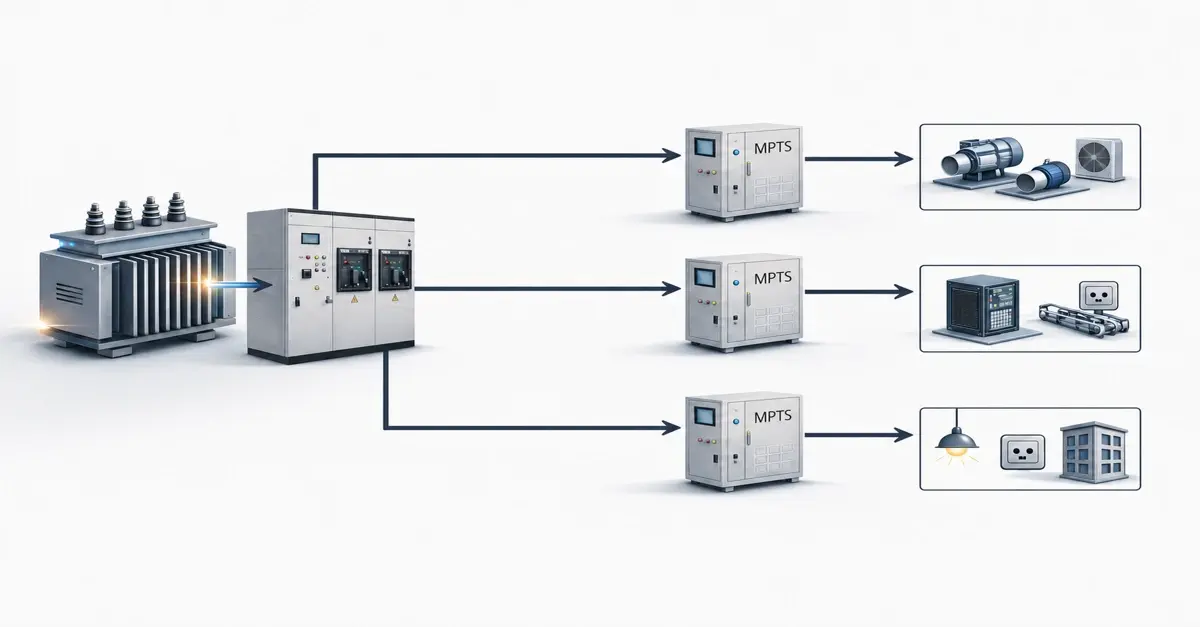
    Both deployments address a critical infrastructure problem: power asset transformers operating beyond 100% capacity (the same applies to BESS, UPS, Gensets, and Solar). The MPTS resolves this by eliminating reactive power, reducing demand load, and recovering usable transformer capacity — deferring or eliminating the need for costly electrical infrastructure upgrades. MPTS is first and foremost a Power Management Control System (PMCS).

    Deployment Comparison Overview

    Metric1× MPTS ($200K)2× MPTS ($400K)
    Capital Investment$200,000$400,000
    Annual OPEX Savings$42,217 – $60,297$85,754 – $129,914
    CAPEX Avoided$140K – $310K$270K – $540K
    Transformer Loading100%+ → 86%100%+ → 77%
    Reactive Power Eliminated400 kVAR → −7400 kVAR → −14
    Payback Period: Both / OPEX / CAPEX1-2 / 3-5 / 1-2 years1-2 / 3-5 / 1-2 years

    OPEX Assessment

    Both deployment scenarios produce strong, recurring operational savings driven by four distinct mechanisms:

    1. Energy Savings
      The 2× MPTS (600 kVA / 450 kW / 400 kVAR / 0.75 PF) deployment eliminates 245,280 kWh annually, and the 1× unit (360 kVA /300 kW / 200 kVAR / 0.83 PF) eliminates 122,640 kWh annually. At $0.12/kWh, this yields annual energy savings of approximately $29,434 and $14,717 respectively — a direct, measurable reduction in utility consumption.
    2. Demand Charge Reduction
      Demand savings follow directly from the kVA reductions achieved. The 2× deployment recovers 136 kVA on a 600 kVA transformer, generating $16,320–$24,480 per year in demand savings. The 1× unit frees 51 kVA on a 360 kVA transformer, yielding a more modest $5,100–$9,180 annually.
    3. Power Factor Penalty Elimination
      Both configurations eliminate power factor penalties charged by the utility. At 2% of the annual utility bill, this adds a clean, predictable saving of $9,000/year for the 2× configuration ($450K annual utility) and $5,400/year for the 1× ($270K annual utility).
    4. Transformer & Cooling Loss Reduction
      Reduced electrical losses in transformers and associated cooling infrastructure, combined with lower mechanical stress on equipment, contribute an estimated $16,000–$32,000 annually (2×) and $12,000–$16,000 (1×), alongside operational and maintenance savings of $15,000–$35,000 and $5,000–$15,000 respectively.
    OPEX Savings Category1× MPTS / Year2× MPTS / Year
    Energy savings (kWh)$14,717$29,434
    Demand charge reduction$5,100 – $9,180$16,320 – $24,480
    Power factor penalty elimination$5,400$9,000
    Transformer & cooling losses$12,000 – $16,000$16,000 – $32,000
    Operational & maintenance$5,000 – $15,000$15,000 – $35,000
    Total annual OPEX savings$42,217 – $60,297$85,754 – $129,914

    CAPEX Assessment

    The more significant financial argument is the deferral and avoidance of capital expenditure. Both scenarios address transformers operating beyond 100% rated capacity. The MPTS resolves this without physical infrastructure replacement, avoiding the following capital outlays:

    Avoided CAPEX Item1× MPTS2× MPTS
    Transformer replacement$30K – $60K$75K – $150K
    Utility infrastructure upgrade$30K – $75K$40K – $80K
    Backup capacity (GenSet/UPS)$50K – $100K$80K – $160K
    Extended transformer service life$30K – $75K$75K – $150K
    Total CAPEX avoided$140K – $310K$270K – $540K

    The 2× deployment reduces transformer loading to ~77%, providing significantly greater headroom for future load growth compared to the 1× unit’s ~86% loading. Both values represent safe operational targets versus the pre-deployment overload condition.

    Payback & Risk-Adjusted View

    The stated 1–2-year payback applies to both configurations and is credible if the CAPEX avoidance items are treated as near-term obligations rather than as hypothetical deferments.

    Key considerations:

    • If the transformer replacement, utility upgrade, or backup power generation has already been budgeted or is imminent, the ROI case is extremely strong, and the net payback may be achieved within the first year.
    • If these expenditures remain discretionary, the OPEX-only payback of approximately 3–5 years remains a reasonable return for electrical infrastructure investment.
    • The 2× deployment delivers approximately 2× the annual OPEX savings and 2× the CAPEX avoidance upside, meaning the incremental $200K investment for the second unit carries the same ROI profile as the first — an unusual characteristic suggesting both transformers are equally stressed.
    • Reactive power correction to a slightly leading condition (−7 to −14 kVAR) is an optimal operating point, providing a built-in voltage-stability margin.

    Strategic Asset Impact

    Beyond the financial metrics, both deployments unlock operational and growth-oriented benefits:

    • Eliminates infrastructure bottlenecks and overload risk without capital construction
    • Enables facility growth without requiring new electrical service or transformer upgrades
    • Improves power reliability, equipment longevity, and energy efficiency
    • Frees 23% of transformer capacity (2×) or 14% (1×) for future load allocation
    • Extends the useful service life of existing transformer assets
    MPTS Financial Impact Summary
    1 × MPTS Deployment — $200K (All inclusive)
    MPTS Financial Impact Summary
    2 × MPTS Deployment — $400K (All inclusive)
    Annual OPEX Savings $86K – $130K Annual OPEX Savings
    (Validated + modeled recurring operational savings)
    $86K – $130K Annual OPEX Savings
    (Validated + modeled recurring operational savings)
    ANNUAL SAVINGS BREAKDOWN
    Energy Savings ~122,640 kWh reduced annually
    ≈ $14,717 / year ($0.12 / kWh)
    ~245,280 kWh reduced annually
    ≈ $29,434 / year ($0.12 / kWh)
    Demand Savings 51 kVA reduction
    ≈ $5,100 – $9,180 / year ($10 – $15 / kW)
    136 kVA reduction
    ≈ $16,320 – $24,480 / year ($10 – $15 / kW)
    Power Factor Penalty Elimination 2% of $270K per annum
    ≈ $5,400 / year (2% of $450K)
    2% of $450K per annum
    ≈ $9,000 / year (2% of $450K)
    Reduced Transformer Losses & Cooling ≈ $12,000 – $16,000 ≈ $16,000 – $32,000
    Operational Efficiency & Maintenance Reduction Lower losses, cooling, and equipment stress
    ≈ $5,000 – $15,000 / year
    Lower losses, cooling, and equipment stress
    ≈ $15,000 – $35,000 / year
    Total Verified Savings $42,217 – $60,297 per year $85,754 – $129,914 per year
    STRATEGIC ASSET IMPACT
    Transformer Capacity Recovered 14% — 51 kVA freed on a 360 kVA transformer 23% — 136 kVA freed on a 600 kVA transformer
    Loading Reduction 100%+ overloaded → ~86% optimized operation 100%+ overloaded → ~77% optimized operation
    Reactive Power Eliminated 400 kVAR → ~ -7 (slightly leading optimal condition) 400 kVAR → ~ -14 (slightly leading optimal condition)
    FINANCIAL INTERPRETATION — AVOIDED / DEFERRED CAPITAL EXPENSE
    Transformer replacement avoided $30K – $60K $75K – $150K
    Utility upgrade $30K – $75K $40K – $80K
    Backup capacity (GenSet/UPS) $50K – $100K $80K – $160K
    Extended transformer service life $30K – $75K $75K – $150K
    Total CAPEX Avoided $140K – $310K $270K – $540K
    EXECUTIVE TAKEAWAY
    Capital Investment $200K (1 × MPTS) $400K (2 × MPTS)
    Recurring Annual OPEX Savings $42K – $60K $81K – $130K
    CAPEX Avoided $140K – $310K $270K – $540K
    Payback ~1–2 years (OPEX / CAPEX included) ~1–2 years (OPEX / CAPEX included)
    Eliminates infrastructure bottlenecks & overload risk
    Enables growth without electrical upgrades
    Improves reliability, efficiency, and asset life
    Eliminates infrastructure bottlenecks & overload risk
    Enables growth without electrical upgrades
    Improves reliability, efficiency, and asset life

    Terminology Reference

    AcronymDefinition
    MPTSMaximum Power Transfer Solution
    PMCSPower Management Control System
    OPEXOperating Expenditure — recurring operational costs
    CAPEXCapital Expenditure — one-time infrastructure investment
    kVAKilovolt-Ampere — measure of apparent power
    kVARKilovolt-Ampere Reactive — measure of reactive power
    kWhKilowatt-Hour — measure of energy consumption
  • Impedance Matching: The Secret to High-Performance Power

    Impedance Matching: The Secret to High-Performance Power

    Modern industrial facilities are losing up to 20% of their electrical capacity because high-tech loads such as AI servers and variable-speed drives operate out of sync with the utility grid. This problem is solved by using real-time impedance matching to stop energy waste and recover hidden capacity in existing infrastructure. By employing high-speed sensors that act as a continuous bridge between the utility and the facility, companies can ensure their equipment runs cooler and more efficiently without needing expensive utility upgrades.

    The Invisible Struggle: Your Building vs. The Grid

    In most large facilities, such as data centers, factories, or hospitals, there is a constant struggle between the power from the grid and the machines that use it.

    The grid provides power in a steady, predictable rhythm. However, modern equipment like AI servers and high-tech motors changes their own electrical signature thousands of times per second. When these two signatures do not align, an impedance mismatch occurs. This clash is expensive because it creates wasted energy, causes equipment to overheat, and limits how much work your facility can actually perform.

    The Power Handshake: Source vs. Load

    To get the most out of your electricity, the Source and the Load must be perfectly balanced.

    • The Source: Power pushing into your building from the utility grid.
    • The Load: Combined electrical signature of your building’s equipment.

    In physics, the Maximum Power Transfer Theorem states that you only get the maximum amount of work when the Load acts as the perfect functional opposite of the Source.

     Impedance matching is the process of getting the grid and your building to row in perfect sync. Think of it like two people rowing a boat. If they are not in the exact same rhythm, their oars hit each other, splashing water and wasting effort. But if they sync up perfectly, the boat moves at its maximum speed with the least amount of work.

    The Real Cost of Being Out of Sync

    When your building and the grid are mismatched, the energy that cannot be used effectively turns into physical problems:

    • Wasted Energy: Power bounces back into the wires instead of running your machines.
    • Heat and Noise: This rejected energy vibrates through your equipment as heat, prematurely wearing out expensive motors and electronics.
    • Instability: Sudden changes in your power can cause sensitive systems to glitch or shut down unexpectedly.

    How MPTS Fixes the Match in Real Time

    Traditional power systems are static, meaning they operate at a single rhythm and cannot change. The Maximum Power Transfer Solution (MPTS) is an active, high-speed engine that corrects this in four steps:

    1. Sense: It listens to the electrical rhythm of your building every millisecond.
    2. Calculate: It figures out exactly how out of sync you are with the grid.
    3. Adjust: It instantly shifts your building’s signature to be the perfect opposite of the grid.
    4. Confirm: It checks the result and adjusts again, instantly, thousands of times a second.

    Why This Matters for Your Operations

    By constantly matching your building to the grid, MPTS ensures that every bit of power you pay for is actually used for work. You get more capacity out of your existing wiring, your equipment runs cooler and lasts longer, and your entire facility becomes a more stable, efficient asset.

    Is your facility truly in sync with the grid? Contact our engineering team today for a Power Alignment Audit to find out how much capacity you can recover and how much equipment life you can save.

  • The 160-Year Problem: Why Jacobi’s Law Took Modern Technology to Solve

    The 160-Year Problem: Why Jacobi’s Law Took Modern Technology to Solve

    The Theory That Changed Electrical Engineering

    In 1840, Moritz Hermann von Jacobi introduced what is now known as the Maximum Power Transfer Theorem, a principle stating that maximum power is transferred when the impedance of the load matches the impedance of the source. While elegant in theory, it remained largely impractical for real-world electrical networks for more than a century.

    The problem wasn’t the math—it was the technology.

    Why Jacobi’s Law Couldn’t Be Applied Until Now

    Electrical systems are dynamic. Loads constantly change, harmonics distort waveforms, and reactive power introduces inefficiencies. Applying Jacobi’s Law in real time requires:

    • Continuous measurement of voltage and current
    • Instantaneous adjustment of network impedance
    • High-speed processing at the waveform level

    These requirements simply weren’t achievable until modern solid-state electronics and microprocessors became available.

    How PMCS Turned Theory Into Reality

    PMCS leveraged modern microchip technology and proprietary algorithms to dynamically match source and load impedance in real time. The result is the Maximum Power Transfer Solution (MPTS)—a system that reduces waste, improves power factor, and optimizes energy efficiency across entire electrical networks.

    Why It Matters Today

    As global energy demand rises, efficiency—not generation—is the fastest way to relieve grid strain. PMCS doesn’t just revisit a 19th-century theory—it operationalizes it for the modern energy landscape.

  • Why Power Factor and Harmonics Are Costing You More Than You Think

    Why Power Factor and Harmonics Are Costing You More Than You Think

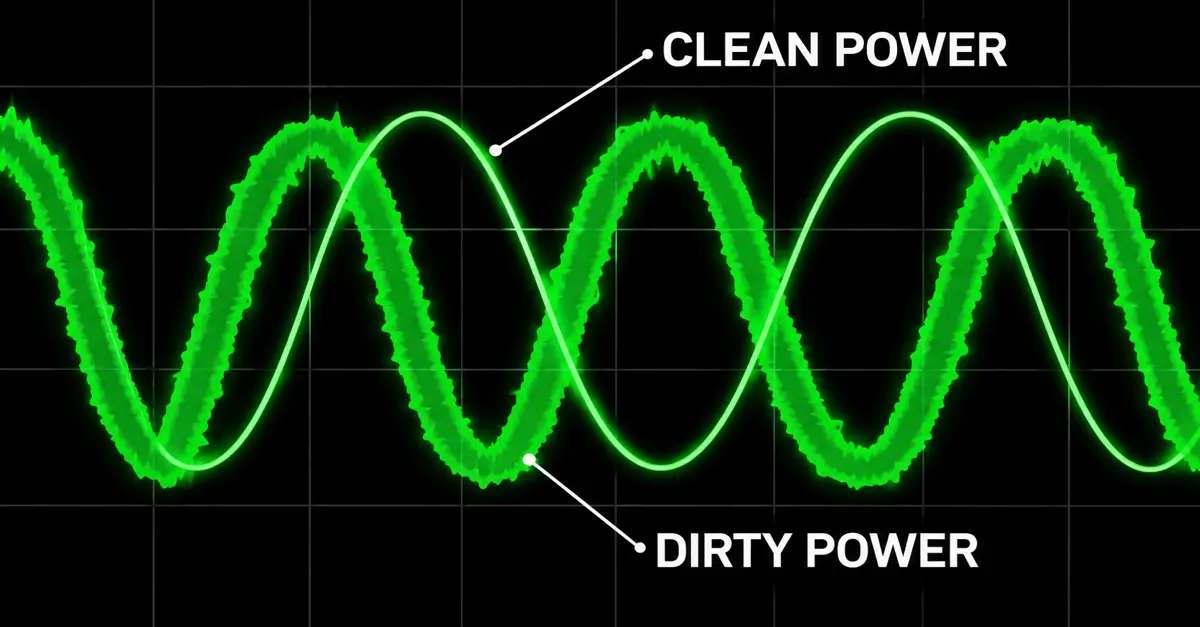
    The Hidden Cost of “Dirty Power”

    Most facilities track kilowatt-hours, but few understand the financial impact of:

    • Reactive power (kVAr)
    • Harmonic distortion (THD)
    • Excess current and heat

    These inefficiencies increase demand charges, reduce equipment life, and strain electrical infrastructure.

    Why Traditional Solutions Aren’t Enough

    Capacitor banks and harmonic filters address symptoms, not systems. They are static, load-specific, and often introduce maintenance challenges.

    The PMCS Approach

    PMCS dynamically manages the entire electrical network in real time, reducing reactive power by up to 90% and consistently achieving power factor levels of 0.95–0.99—without capacitor banks.

  • The Global Energy Crisis Isn’t About Shortage—It’s About Waste

    The Global Energy Crisis Isn’t About Shortage—It’s About Waste

    Energy Waste Is the Real Crisis

    From utilities to industrial facilities, massive amounts of generated power never become useful work. Losses from reactive power, harmonics, and inefficient demand management quietly consume capacity.

    Why Efficiency Beats New Generation

    Building new power plants takes years. Improving efficiency delivers immediate results. PMCS reduces demand at the source, freeing capacity without new infrastructure.

    A Faster Path to Sustainability

    By reducing waste, PMCS lowers emissions, stabilizes grids, and helps organizations meet sustainability goals without offsets or operational changes.

  • Why Electrical Capacity Is the New Bottleneck—and How Facilities Can Solve It Without Upgrades

    Why Electrical Capacity Is the New Bottleneck—and How Facilities Can Solve It Without Upgrades

    Electrical Capacity Is the Real Limiting Factor

    Across commercial, industrial, and institutional facilities, electrical capacity is becoming a critical bottleneck. While power generation continues to expand, the ability of existing infrastructure—transformers, panels, switchgear, and feeders—to support new loads is increasingly limited.

    From EV charging and electrification initiatives to data centers and HVAC upgrades, demand is rising faster than infrastructure can be expanded.

    Why Traditional Upgrades Are Expensive and Slow

    When facilities hit capacity limits, the default response is infrastructure expansion:

    • Larger transformers
    • New service feeds
    • Utility coordination
    • Construction downtime

    These projects are costly, disruptive, and often take months or years to complete. In many cases, facilities are forced to delay growth or defer sustainability initiatives simply because the electrical system cannot support additional load.

    The Hidden Truth: Most Facilities Already Have Untapped Capacity

    What many organizations don’t realize is that electrical capacity is often wasted, not fully utilized. Excess current, poor power factor, harmonic distortion, and reactive power inflate kVA demand without delivering useful work.

    In other words, facilities appear “maxed out” on paper—but in reality, a significant portion of their electrical capacity is being consumed by inefficiency.

    How PMCS Unlocks Capacity Without Infrastructure Changes

    PMCS addresses capacity constraints by reducing the electrical waste that inflates demand. By dynamically matching source and load impedance in real time, the PMCS Maximum Power Transfer Solution (MPTS) lowers:

    • Line current
    • kVA and kVAr demand
    • Peak load conditions

    This releases up to 20% of hidden electrical capacity, allowing facilities to add new loads, downsize backup generation, or export excess power—without replacing transformers or upgrading service connections.

    Capacity Relief That Scales With Demand

    Unlike static solutions, PMCS adapts continuously as loads change. Whether a facility is adding EV chargers, expanding operations, or integrating renewable energy, MPTS ensures the existing electrical network operates as efficiently as possible.

    This makes PMCS not just an efficiency tool, but a strategic capacity solution for modern electrification challenges.

    A Smarter Path Forward

    As energy demand continues to rise, solving capacity constraints will require more than building new infrastructure. The fastest, most cost-effective solution is to eliminate waste first.

    PMCS enables facilities to do exactly that—turning efficiency into available capacity and helping organizations grow without delay.

Click to talk