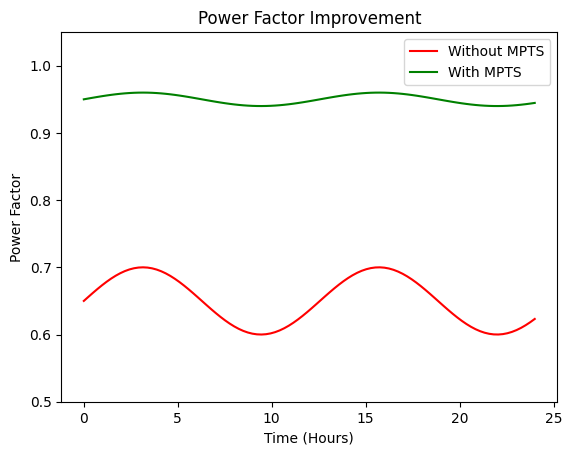
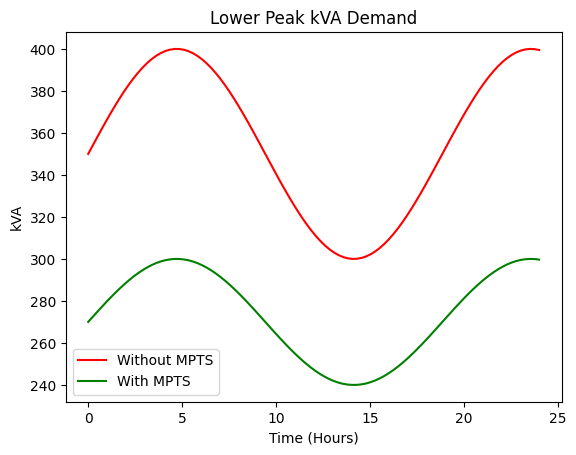
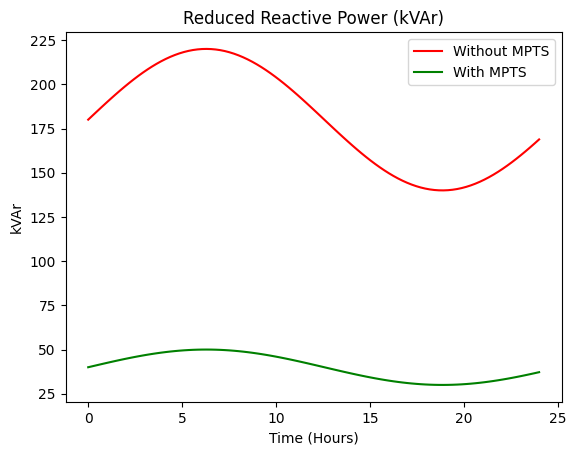
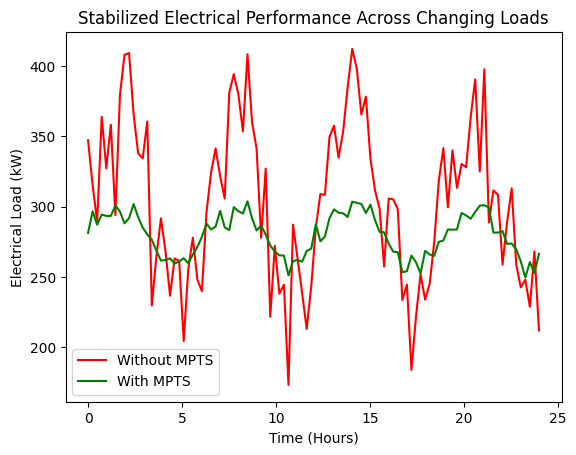
Cheyenne Mountain Air Force Station, home to NORAD operations, is one of the most secure and mission-critical facilities in the United States.
The installation focused on a 160 HP air compressor (CO1) supporting base operations, where power quality, reliability, and efficiency are non-negotiable.
The Challenge
Prior to MPTS installation, the compressor exhibited:
Poor load-side power factor (~0.30)
Excessive current draw
High reactive power (kVAr)
Unnecessary electrical stress on upstream infrastructure
In a hardened military environment, improving efficiency without introducing risk was essential.
The Solution
An MPTS-450/3/60 unit was installed directly on the air compressor circuit, with comprehensive monitoring conducted using a calibrated power analyzer.
Performance was measured under three conditions:
Compressor OFF / MPTS OFF
Compressor ON / MPTS OFF
Compressor ON / MPTS ON
The Results
Power Quality Improvements
Power factor improved from ~0.30 to ~0.998
Line current reduced from ~196 A to ~134 A under load
kVA demand reduced from 104 to 31
Reactive power reduced from 95 kVAr to 13 kVAr
Carbon & Efficiency Impact
70% reduction in CO₂ emissions
68,255 lbs of CO₂ eliminated annually
Significant reduction in electrical stress and heat losses
All results were measured, logged, and verified using independent instrumentation
Why This Matters
This project proves that MPTS is not only suitable for commercial buildings — it performs in the most demanding defense environments.
When power quality improves, everything downstream benefits: reliability, efficiency, and mission readiness.
The U.S. General Services Administration (GSA) operates a pumping station at Federal Center Building 8 in Denver, Colorado, supporting essential federal infrastructure.
The station includes seven VFD-controlled pumps, with one pump operating at a time, making efficiency under partial load conditions especially important.
The Challenge
Despite limited active operation, the pumping station experienced severe inefficiencies:
Power factor as low as 0.18
44 kVAr of reactive power on each VFD circuit
Excessive no-load current draw
Unnecessary energy consumption and demand costs
The result was wasted electrical energy even when pumps were idle.
The Solution
Accentz Inc. installed an MPTS unit to correct power quality at the load level. The project included:
Pre-installation meetings and site inspection
Installation and commissioning
Measurement & Verification (M&V) using live monitoring
Side-by-side comparison of pre- and post-MPTS performance
The Results
The results were immediate and independently verified:
Electrical & Energy Performance
82% reduction in no-load current (54 A → 9.72 A)
25.6% reduction in on-load current
Reactive power reduced from 44 kVAr to 2 kVAr
Power factor improved from 0.18 to 0.98
35.61 kW of estimated demand reduction
Financial Impact
314,613 kWh annual energy savings
$31,461 in estimated annual cost savings
ROI achieved in less than one year
These improvements were confirmed by the GSA Resource Efficiency Manager, validating the technology in a federal operating environment
Why This Matters
For infrastructure with intermittent load operation, power quality losses can dominate energy costs.
MPTS eliminated waste even when equipment was not actively producing work, transforming idle electrical loss into recovered capacity.
Morgan County Prison is a 377,000-square-foot correctional facility located in Fort Morgan, Colorado. The facility houses up to 325 detainees and operates 24 hours a day, 365 days a year.
Built originally in 1898, with expansions over the decades, the complex now includes:
HVAC chillers
Pumps and motors
Laundry operations
Cafeteria facilities
Security systems
Automation controls
Electronics and computer systems
A 200+ kW solar installation
As a mission-critical public safety facility, reliability, resilience, and energy efficiency are essential.
The Challenge
Correctional facilities are among the most electrically demanding building types. Morgan County Prison faced:
High peak demand charges
Variable and constantly changing electrical loads
Harmonics and transient voltage issues
Stress on motors, pumps, and HVAC equipment
A 24/7 operational requirement with no tolerance for downtime
Even with existing conservation measures and solar generation, inefficiencies in the electrical network were driving unnecessary demand and increasing operating costs.
The Facilities Director, known for exploring innovative efficiency technologies, first encountered MPTS in 2012. After due diligence and demonstration, the county installed its first MPTS unit in the county office.
The results were strong enough that in 2020, funding was approved for an additional MPTS installation at the prison complex.
The Solution
In June 2020, Morgan County Prison commissioned the MPTS (Maximum Power Transfer Solution) system within its electrical network.
MPTS was installed to improve power quality and optimize real power usage across the facility’s complex load profile.
Unlike passive monitoring systems, MPTS:
Reduces total electrical demand (kW)
Lowers total kVA (generation requirement)
Mitigates harmonics
Reduces transient voltages
Improves power factor
Cleans and recycles wasted electrical energy within the network
The system was installed with:
No operational interruption
No mechanical retrofits
No replacement of existing equipment
Zero maintenance requirement since commissioning
The Results
The performance has been measured and verified by two independent metering systems:
Accuenergy metering system
MPTS Power Management & Metering System
Peak Demand Reduction
30% reduction in Peak Demand
Average 70 kW reduction compared to benchmark
Over 70 kW savings at any given moment in a 24-hour operation
For a continuously operating prison, this represents sustained, measurable cost reduction — not just momentary efficiency gains.
Electrical Efficiency Improvements
The six-month performance graphs (2022–2023) show consistent performance across varying seasonal demand, proving long-term stability — not short-term anomaly
Carbon Footprint Reduction
EPA greenhouse gas equivalency calculations (shown in the report) demonstrate:
435 metric tons of CO₂ reduced
Equivalent to:
96.7 gasoline-powered passenger vehicles driven for one year
1,114,026 miles driven by an average gasoline vehicle
48,899 gallons of gasoline consumed
42,688 gallons of diesel consumed 17-Morgan-County-Prison-case-st…
This reduction occurs without replacing equipment — simply by improving how electricity is used inside the building.
Key Performance Metrics
Metric
Before MPTS
After MPTS
Improvement
Peak Demand
High
30% Reduction
Major Utility Savings
Energy Demand
Benchmark
-70 kW Average
Continuous 24/7 Savings
Power Factor
Variable
Significantly Improved
Higher Efficiency
kVA Load
Elevated
Reduced
Lower Generation Requirement
Harmonics & Transients
Present
Mitigated
Greater Reliability
CO₂ Emissions
Baseline
-435 Metric Tons
Sustainability Impact
Operational Benefits
In addition to energy savings, the installation delivered:
Improved electrical network resilience
Reduced mechanical and electrical stress
Better performance under changing loads
Enhanced reliability for mission-critical systems
Long-term maintenance-free operation
For a correctional facility, reliability is not optional — it is operationally critical.
Why This Matters
Morgan County Prison demonstrates a powerful reality:
You don’t have to replace equipment to unlock capacity.
By cleaning and recycling wasted electrical power within the building, MPTS reduces:
Electrical demand
Generation requirement (kVA)
Carbon footprint
Infrastructure strain
All while increasing resilience.
In a 377,000 sq. ft. 24/7 facility, even small improvements compound. A consistent 70 kW reduction becomes transformational.
Casas Church is a large and active community church located in Tucson, Arizona. With expansive facilities and year-round HVAC demands driven by the desert climate, energy efficiency plays a critical role in managing operational costs while maintaining a comfortable environment for congregants and staff.
Committed to responsible stewardship and long-term sustainability, Casas Church began exploring advanced solutions to reduce unnecessary energy waste and improve the performance of its electrical systems.
The Challenge
An analysis of the church’s HVAC chiller revealed significant inefficiencies:
Current draw of 129 amps
Power factor between 44% and 52%
Excessive reactive power and wasted demand
Higher-than-necessary utility and demand charges
Increased electrical and mechanical stress on HVAC equipment
Despite consuming large amounts of electricity, only a fraction of that power was being converted into useful work. The remainder was lost due to poor power quality—driving up costs without improving performance.
The Solution
To address these inefficiencies, Casas Church deployed the PMCS Power Power Management Controls System on its HVAC chiller.
Unlike passive monitoring tools, the PMCS system actively optimized the electrical performance of the chiller by:
Continuously correcting power factor
Reducing reactive power (kVAr)
Stabilizing electrical demand
Improving overall power quality in real time
The installation and commissioning process was seamless and required no interruption to church operations—an essential requirement for a high-traffic community facility.
The Results
The impact was immediate and measurable.
After installation, Casas Church achieved:
50% reduction in energy demand
Significantly improved power factor
Lower monthly electricity and demand charges
Reduced electrical and mechanical stress on HVAC components
Improved system reliability and longevity
By eliminating wasted power rather than adding new infrastructure, the church was able to unlock savings using the energy it was already paying for.
Key Performance Metrics
Metric
Before PMCS Power
After PMCS Power
Improvement
Current Draw
129 Amps
Reduced & Optimized
Lower Demand
Power Factor
44–52%
Significantly Improved
Higher Efficiency
Energy Demand
High
50% Reduction
Major Cost Savings
What the Customer Says
“The installation of the PMCS Power system significantly reduced energy demand while ensuring efficient operation of our HVAC system.”
Why This Matters
Casas Church’s success highlights a critical truth about energy efficiency:
You don’t always need more power—you need better power.
By improving how electricity is used rather than how much is produced, PMCS Power delivers immediate, verifiable savings without waiting years for infrastructure upgrades or regulatory changes.
This project now serves as a model for:
Churches and community facilities
Commercial buildings
Schools and campuses
Data centers and mission-critical HVAC environments
In the energy sector, claims require proof. Certification from organizations like Underwriters Laboratories (UL) is one of the most rigorous validation processes in the industry.
The UL Testing Process
UL required two units of each of PMCS’s eight MPTS models—16 systems in total—to undergo extensive testing. Over nine months, UL evaluated:
Power quality improvements
Current and demand reduction
Power factor correction
System reliability across configurations
What Happened After Certification
Following approval, UL acquired an MPTS unit for ongoing benchmarking. It is now used internally for comparative testing against other power technologies—a rare endorsement that speaks to PMCS’s performance consistency.
What This Means for Customers
UL certification confirms that PMCS delivers measurable, repeatable improvements under real operating conditions. For facilities, utilities, and institutions, this validation reduces adoption risk and reinforces long-term confidence.
Douglas County School District in Colorado provided a rare opportunity: two nearly identical high schools, located just two miles apart, with similar:
Square footage
Student populations
Mechanical systems
Operating schedules
One school installed PMCS. The other did not.
What the Data Showed
Over 18 months, utility-provided data revealed:
14.5% reduction in peak kW demand
8.28% reduction in total kWh consumption
Improved power quality across HVAC, lighting, and mechanical systems
Why This Case Study Matters
Unlike short trials or simulations, this long-term comparison eliminated variables. The results confirmed PMCS delivers sustained, verifiable efficiency gains in real facilities—not just controlled environments.